Saturday, May 2, 2020
Ideas, Ideas
The first idea I have for marketing my library's fiction section is a display. Depending on which television, gaming, or movie franchise is growing in popularity at the time. I will have a display of Read-A-Likes. For example, the signs would read something along the lines of "If you enjoy [insert name her] give this book a try". With this, patrons who like one thing are able to find similar themes or aspects in a different medium. It is an example of passive Reader's Advisory that we discussed over the duration of this course.
The second idea is a week long program that would revolve around Young Adult Fiction. Each day there would be a different activity for all patrons to participate in. For example, there would be activity based on certain popular Young Adult books. Like making an archery event to highlight the Hunger Games series or an event based on Mythology for the Lightning Thief series. And, if the program were to receive enough popularity and funding, even have authors come in for a Questions and Answers event. My hope with this is to promote Young Adult Fiction to more than just teens.
The final idea is in the same vein as the first. Only instead of a display, it would be posters and other forms of signage. It can be a more permanent form have passive Reader's Advisory that would require less work for the staff. My library has received such signage in the past from publishers and it has been successful. Displays, while fun to create and think of, take much time and work to implement. With signage, it will allow patrons to get ideas for future readings but also free up staff to work on other tasks.

Friday, April 24, 2020
African American Fiction: An Annotation

The Supremes at Earl's All-You-Can-Eat
Written by Edward Kelsey Moore
Narrated by Pamella D'Pella and Adenrele Ojo
Duration: 12:25:16
ISBN: 9780385362900
Publication: March 12, 2013
Plot Summary
In this book, readers meet Odette, Clarice, and Barbara Jean aka "The Supremes" in Plainview, Indiana. Friends since high school, these three different women have led different lives but have always stayed next to one another. Each woman is tested with hardships that had the power to break them and their friendship apart. Readers are able to grow with "The Supremes" over the course of their friendship which spans over forty years. This is a very touching story that brings humor to the subjects of loss, growth, and mortality.
Readers should like this book if they enjoy books with:
*Own voices Storylines
*Culturally Diverse Characters
*Engaging Writing Styles
What Makes an African American Fiction Book?
Because African American Fiction is an Own Voice subgenre, in order for a book to be consider as such the author has to be of African decent writing about African Americans. That is really the only main factor that is considered with it comes to this genre.
Common themes in African American Fiction include African American culture, racism, and spiriual development.
Read-A-Likes
*Who asked you? by Terry McMillan
*In West Mills by De'Shawn Charles Winslow
*Miss Dreamsville and the Collier County Women's Literary Society by Amy Hill Hearth
Friday, April 17, 2020
Legitimate Genres
My first thought when people come after a genre because it isn't a "legitimate" read is, "And your findings are based on your opinion, simmer down". It takes to much unnecessary effort to be so negative over something that doesn't affect you. I have gotten into debates with friends and colleagues about the merits of certain genres (Romance and Young Adult).
I will admit that I once thought of these genres as "trash reading" but over time, I have come to realize that this was because that is what I was taught to think. From elementary to even into college, it is implied that the only books worth reading are the classics or sophisticated literary fiction. Since working for a library, I have developed the mentality that the only qualification for a book worth your time is one that you want to read.
I think the first step to breaking the stigma towards any genre is to stop that train of thinking early on. Or even have debates with patrons on the subject but no allowing it to get any more heated than a friendly discussion. I use the argument that many people use reading an escape from their own reality and we all have different ideas of where we'd like to escape to.
All books are for everyone, regardless of age.
Another way to expose more people to genres like Young Adult and Graphic Novels is when creating Reader's Advisory Displays is to include these novels as well. For example, if the display is for memoirs, include Graphic Novel memoirs in the mix. Sometimes the way to introduce someone to a whole new genre is to present them with something very similar to what they already like to read.
There are bigger fish to fry, read what you want and let others do the same.
Thursday, April 16, 2020
An Young Adult Annotation

House of Salt and Sorrows written by Erin A. Craig
Narrated by Emily Lawrence
ISBN: 9780593102930
Duration: 12:50:43
Released: August 6, 2019
Plot Summary:
This novel is an eerie retelling of Brothers Grimm's Twelve Dancing Princesses. The reader follows the perspective of Annaleigh as she tries to uncover the sources of her older sisters deaths. The townspeople are convinced that there is a curse on her and her twelves sisters that will not rest until the whole lot of them are returned to the salt of the sea.
Annaleigh doesn't believe any of it until she discovers that her youngest sister is visited by the ghosts of the sisters that have perished. Soon after, Annaleigh begins to see the apparitions for herself. All the while, her remaining sisters go off to secrets places via a magical passageway not heeding Annaleigh's warnings. Is it truly a curse or something much more sinister and will Annaleigh be able to save her family before she is claimed as well? Take your motion sickness pills because this trip with have some many unknown twists and turns you might go mad yourself.
What Makes an YA Book?
Character Focus: In order for a Young Adult to be classified as such, publishers need to consider who the main characters are. The main characters of Young Adult books range from thirteen to eighteen.
Plot: Because of the age of the main characters in these novels, the plot is often driven by typical teenage issues. Examples of these would be first love, puberty, and changes in family dynamic. Even even Fantasy Young Adult novels these issues are present.
Pacing/Tone: Young Adult books tend to be a fast paced read. Even longer ones are only so long because of the descriptions of action scenes. In addition, the dramatic tones of Young Adult books play into the pacing.
Reader Will Enjoy This Book if They Like
*Descriptive Writing Styles
*Gothic fiction
*Retelling
Read-A-Likes
*Strange grace by Tessa Gratton
*The waking forest by Alyssa Wees
*Beastkeeper by Cat Hellisen
Sunday, April 12, 2020
Beware, You are About to Enter the Matrix

Author: Mark Parker
Title: Humble Pi: A Comedy of Maths Errors
Publication Date: January 21, 2020
Duration: 09:33:19
Setting: Various
Time Period: Various
Subject Headings: Mathematics, Popular Works, Humor
Book Summary: Mathematician, Mark Parker, takes readers on a tour around the world and through time illustrate how seemingly small miscalculations can result disastrous unintended consequences with real examples.
1. Where is the book on the narrative continuum?
---A Mix of narrative and fact based
2. What is the subject of the book?
---A story of how mathematics, if not done correctly, can lead to humiliating blunders and even fatalities.
3. What type of book is it?
---A humorous science book.
4. A.Pacing?
---Fast paced but still offers the reader a whole world of knowledge.
B. Characters?
----Although the people in this book made mistakes due to lack of forethought or a coding error, Mark Parker doesn't speak evil of them. He uses their mistakes to highlight the importance of mathematics in everyday life.
C. How does the story feel?
---Upbeat, humorous,
D. Author's intent?
---To provide insight to the common person about how these mistakes had been made by intelligent persons.
E. Does the language matter?
---YES
F. Is the setting important and well described?
---Since the accounts take place locations and different times, the setting is very important to this story. Parker does a good job painting the picture of the setting without overwhelming the reading with needless details.
G. Are there details and of what?
---Parker goes most into detail about different computer programs and codes along with mathematical computations.
H. Does the book stress moments of learning, understanding, or experience?
---The book stresses most on the importance of learning from and understanding how mistakes take place.
I. Any graphs?
---Not in the audiobook
5. Why would a reader enjoy this book?
---learning, humor, passion of the author about the subject matter
Sunday, April 5, 2020
The Beauty of Audiobooks and Ebooks.
For audiobooks, there is an additional appeal factor to consider and that is the narration. The pacing, dictation, and even just the voice of the narrator can make or break the audiobook. Personally, I have stopped an audiobook in the first few chapters if the narration is not done well. Much like voice over work for television, book narration is a craft that takes practice to be successful.
Typically there is music set at the beginning and at the end of an audiobook, but this is not always the case. For example, I haven't come across any Non-Fiction audiobooks that provide music.
Another major plus for audiobooks is that the listener is able to control the speed of the narration. If the patron wants to just truck through the rest of the book or needs to slow it down, they have the ability to do so.
For Ebooks, I think patrons like having the power to control the size and style of the front. It gives them more control in order for them to read comfortably. The only down side, that I can tell, is that patrons don't right away how long the novel is. I don't think that Ebooks affect the pacing or tone of the novel. It only digitizes the books but doesn't add anything to it like audiobooks do.
A major plus for Ebooks is the convenience it provides to patrons. They are able to take their books anywhere they go without all of the extra weight. I have had many patrons in the past come to me for last minute help downloading books to their phone before they go on a big trip.
Audiobooks and Ebooks are great resources for patrons. It expands the audience that authors can reach by providing their books in different mediums.
Friday, April 3, 2020
A Western Annotation
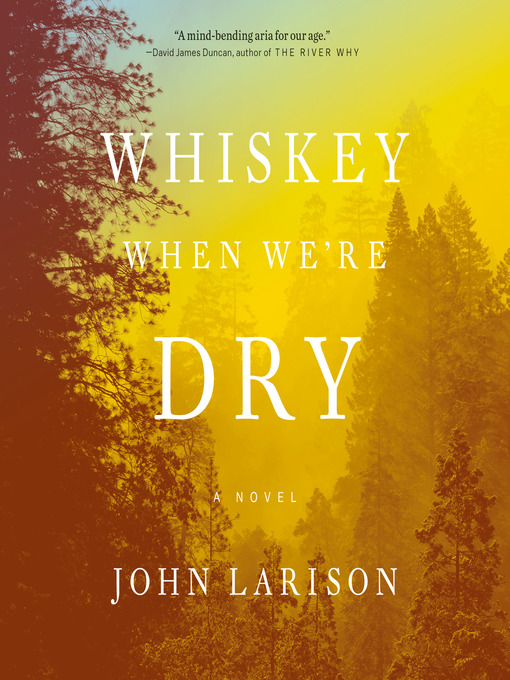
Whiskey When We're Dry
Written By John Larison
Narrated by Sophie Amoss
ISBN: 9780525631163
Run Time: 15:32:54
Summary:
In 1885, Jessilyn Harney sets out on to find her older brother who has become an outlaw since leaving home five years prior. As a girl going out into the unknown by herself, Jessilyn would be under constant threat by predatory men. It is because of this that Jessilyn decides to go on her quest disguised as a man.
During her journey, Jess uses her talent with sharpshooting to earn herself a living. Over the course of a few months, Jess earns a name for her(or rather him)self in addition to collecting information about her brother. As Jess learns more about her brother's crimes, she also learns that not everyone feels the same animosity towards him.
She soon comes to realize that everything in this life isn't black and white. While coming to grips with her own identity, Jess must also make choices that the wrong one could result in her demise. This book will keep its readers on the edge of their seats until the end.
What Makes A Western
Setting/Framing
Western novels take time with the illustration of its setting. The stories often takes place during a time when a family had to rely on what their land could provide them and the cattle they cared for. Because of all the time and descriptions that go into the landscape, the backdrop becomes a character in its own right.
Characterization
The main character of Westerns are typically depicted as a loner. Often the loner is set out on a quest that will right a wrong done to them or their loved ones. It could be multiple wrongs that take over the course of several books to rectify or an one time journey. Joyce Sarcisks compares Western Heroes to detectives in Hard Boiled Mystery books because of their cold exterior and because they sometimes have to solve mysteries as well.
Story Line
Western books often have a common theme of good versus evil. The hero is forced to up against an evil whether it be the sheriff or police, a rival, or "the establishment".
Pacing
Traditionally, Western books are smaller in size but that doesn't mean that they are fast paced books. With all of the world building that goes into the them, the details, although important, slow down the pace of the novel.
Language
Characters in Western novels are described as having limited education. Because of this, the language between characters and internal thoughts are simple in nature. The writing style of Westerns are lyrical and the sparse language is a key factor into making that happen.
Great For Readers Who Enjoy
*First Person Narratives
*Lyrical Writing Style
*Coming-Of-Age Stories
*Character Driven Novels
*Strong Female Characters
Read-A-Likes
* The untold by Courtney Collins
*Caroline by Sarah Elizabeth Miller
*The high divide by Lin Enger
During her journey, Jess uses her talent with sharpshooting to earn herself a living. Over the course of a few months, Jess earns a name for her(or rather him)self in addition to collecting information about her brother. As Jess learns more about her brother's crimes, she also learns that not everyone feels the same animosity towards him.
She soon comes to realize that everything in this life isn't black and white. While coming to grips with her own identity, Jess must also make choices that the wrong one could result in her demise. This book will keep its readers on the edge of their seats until the end.
What Makes A Western
Setting/Framing
Western novels take time with the illustration of its setting. The stories often takes place during a time when a family had to rely on what their land could provide them and the cattle they cared for. Because of all the time and descriptions that go into the landscape, the backdrop becomes a character in its own right.
Characterization
The main character of Westerns are typically depicted as a loner. Often the loner is set out on a quest that will right a wrong done to them or their loved ones. It could be multiple wrongs that take over the course of several books to rectify or an one time journey. Joyce Sarcisks compares Western Heroes to detectives in Hard Boiled Mystery books because of their cold exterior and because they sometimes have to solve mysteries as well.
Story Line
Western books often have a common theme of good versus evil. The hero is forced to up against an evil whether it be the sheriff or police, a rival, or "the establishment".
Pacing
Traditionally, Western books are smaller in size but that doesn't mean that they are fast paced books. With all of the world building that goes into the them, the details, although important, slow down the pace of the novel.
Language
Characters in Western novels are described as having limited education. Because of this, the language between characters and internal thoughts are simple in nature. The writing style of Westerns are lyrical and the sparse language is a key factor into making that happen.
Great For Readers Who Enjoy
*First Person Narratives
*Lyrical Writing Style
*Coming-Of-Age Stories
*Character Driven Novels
*Strong Female Characters
Read-A-Likes
* The untold by Courtney Collins
*Caroline by Sarah Elizabeth Miller
*The high divide by Lin Enger
Monday, March 30, 2020
Historical Fiction Annotation

The Romanov Empress
Written by C.W. Gortner
Narrated by Katharine McEwan
Run time: 17h:49m:58s
ISBN: 9780525593652
Plot Summary
This story is told from the point of view of Maria Feodorovna, the mother of Russia's last Tsar. Readers meet Maria when she is about fifteen years old in her home land of Denmark and follow her until she and her family flee Russia as rebels dismantle the Romanov monarchy. Readers who are familiar with Russian history will know of what becomes of Maria and her family. However, C.W Gortner tells tragic end of the Romanovs with such elegance that listeners will undoubtedly be hooked on the narrator's every word until the very end.
What Makes This Novel Historical Fiction
Frame/Setting
With Historical Fiction novels, authors emphasizes a sense of place. The concept of 'world-building' is crucial in these types of novels. Customs, habits, culture, and so much more are drawn from the world from which the story takes place. Many readers find themselves drawn to type of framing when its foundation is based on these. It is a way for the reader to learn about a different culture without them even knowing it.
Tone
Another important factor for Historical Fiction is the tone. It can leave the reader feeling hostage to the story, when if they already know the outcome of that particular historical event.
Storyline
Unsurprisingly, the story lines of Historical Fiction novels emphasize a certain event, person, or time period.
Pacing
Generally, because of all the world-building and attention to details, Historical Fiction books often are hearty reads. Even when the book is centered around an action filled or adventurous time in history, Historical Fiction books are not considered fast paced reads.
Language
The language in a Historical Fiction story depends on where and when the story takes place. It speaks to the historic cultural accuracy of the piece.
Frame/Setting
With Historical Fiction novels, authors emphasizes a sense of place. The concept of 'world-building' is crucial in these types of novels. Customs, habits, culture, and so much more are drawn from the world from which the story takes place. Many readers find themselves drawn to type of framing when its foundation is based on these. It is a way for the reader to learn about a different culture without them even knowing it.
Tone
Another important factor for Historical Fiction is the tone. It can leave the reader feeling hostage to the story, when if they already know the outcome of that particular historical event.
Storyline
Unsurprisingly, the story lines of Historical Fiction novels emphasize a certain event, person, or time period.
Pacing
Generally, because of all the world-building and attention to details, Historical Fiction books often are hearty reads. Even when the book is centered around an action filled or adventurous time in history, Historical Fiction books are not considered fast paced reads.
Language
The language in a Historical Fiction story depends on where and when the story takes place. It speaks to the historic cultural accuracy of the piece.
Great For Readers Who Enjoy
*Compelling Writing Styles
*Illustrates Life During War Times
*Has An Atmospheric Tone
*Illustrates Life During War Times
*Has An Atmospheric Tone
Read-A-Likes
1. Sisi by Allison Pataki
2. The Romanov bride by Robert Alexander
3.Enchantments by Kathryn Harrison
1. Sisi by Allison Pataki
2. The Romanov bride by Robert Alexander
3.Enchantments by Kathryn Harrison
Saturday, March 14, 2020
A Funny Thing About Book Clubs
In the library system that I work for, there are many different book clubs run by the librarians. Each one is tailored to that specific branch because different branches serve different audiences. What might be successful at one location may completely fail at another.
I ended up shadowing a book club that was located at one of the city branches. The name of this book club is "Book Talkers" with attendance averaging roughly five to twelve participants each meeting. There is no formal attendance taken but the number of participants is recorded for statistical purposes. However, there is the option to give your email address to the librarian at the end of the meeting to receive a copy of the notes that were taken and get a reminder when the next meeting was coming.
What makes this book club, and the majority of the book clubs that the library system hosts, unconventional from others is that members are not asked to read a specific book or certain genre. Members are only asked about what they have read since the last time they met and to give their thoughts about it.
Everyone in the book club sits in chairs arranged in a circle. The librarian who is leading the group goes first to share what books she has read, along with a short summary of what she did or did not enjoy. From there, members take turns going around the circle to share the same. If a member has not read anything noteworthy or anything at all in the past month, there is no shame for them to admit it to the group. The group seems kind to one another and offer no judgment during the discussion. It appears to be a safe place for people in the group.
Because there is no set book for the group to read, a member’s share time depends on how much they read since the last meeting. No one member seemed to hog the spotlight because everyone had an opportunity to speak. If the librarian found the book a member was discussing to be interesting, she would ask more probing questions. Some examples of the questions would be “Is this the first book you read by that author? Who would you recommend this book to?”. Mostly, the librarian would play the part of a facilitator in order for all members to have the opportunity to participate.
The book club does not offer snacks but the members do not seem to mind that. The members seem to look forward to coming back month after month. It is actually one of the libraries few events that do not offer refreshments. However, sometimes the librarian is able to give away advanced copies of books for the group to choose from.
I spoke with the librarian after the meeting and she stated that members would come up to her to talk about books and ask for more book recommendations. Before this group started, the members would not stay in the library long at all. But now they seemed to have formed a small community amongst themselves.
I ended up shadowing a book club that was located at one of the city branches. The name of this book club is "Book Talkers" with attendance averaging roughly five to twelve participants each meeting. There is no formal attendance taken but the number of participants is recorded for statistical purposes. However, there is the option to give your email address to the librarian at the end of the meeting to receive a copy of the notes that were taken and get a reminder when the next meeting was coming.
What makes this book club, and the majority of the book clubs that the library system hosts, unconventional from others is that members are not asked to read a specific book or certain genre. Members are only asked about what they have read since the last time they met and to give their thoughts about it.
Everyone in the book club sits in chairs arranged in a circle. The librarian who is leading the group goes first to share what books she has read, along with a short summary of what she did or did not enjoy. From there, members take turns going around the circle to share the same. If a member has not read anything noteworthy or anything at all in the past month, there is no shame for them to admit it to the group. The group seems kind to one another and offer no judgment during the discussion. It appears to be a safe place for people in the group.
Because there is no set book for the group to read, a member’s share time depends on how much they read since the last meeting. No one member seemed to hog the spotlight because everyone had an opportunity to speak. If the librarian found the book a member was discussing to be interesting, she would ask more probing questions. Some examples of the questions would be “Is this the first book you read by that author? Who would you recommend this book to?”. Mostly, the librarian would play the part of a facilitator in order for all members to have the opportunity to participate.
The book club does not offer snacks but the members do not seem to mind that. The members seem to look forward to coming back month after month. It is actually one of the libraries few events that do not offer refreshments. However, sometimes the librarian is able to give away advanced copies of books for the group to choose from.
I spoke with the librarian after the meeting and she stated that members would come up to her to talk about books and ask for more book recommendations. Before this group started, the members would not stay in the library long at all. But now they seemed to have formed a small community amongst themselves.
Sunday, March 8, 2020
Special Topic: Audiobooks
For my Special Topic Paper, I choose to do it on audiobooks and explain how it is not "cheater reading". For myself, I enjoy listening to audiobooks and it is actually my preferred medium (second to Graphic Novels). In this paper, I provide three different articles to explain how audiobooks are not cheating but just another way for people to take in the story or information.
BookRiot's Dana Lee explains that audiobooks are able to elicit more of an emotional response from the reader. They have the able to do that because the listener is able to hear the narrator's change in pace, tone, and other nuances that come with speech. Because of this, listening to audiobooks can be considered a more social experience than just reading the book in print.
Cognitive psychologist Daniel Willingham, uses the simple model to describe how reading books and listening to books are fundamentally the same. The simple model was developed in 1986 and dealt with the key main functions that take place when an individual is reading---decoding and language processing. In this aspect, reading and listening to a story are the same but Willingham explains that it is easier for a person to take in the information from an audiobook if the text is written similar to oral speech. A person who is trying to study or take in research from an audiobook may have a more difficult time because these types of books typically are written in a more formal matter.
The goal of any story is to be heard and understood by the reader. Everyone is different which means that everyone has a different way that they best take in information. It should not matter how something is understood as long that it is. That is why books are offered as audiobooks in the first place, in order to reach and be understood by as many people as possible.
BookRiot's Dana Lee explains that audiobooks are able to elicit more of an emotional response from the reader. They have the able to do that because the listener is able to hear the narrator's change in pace, tone, and other nuances that come with speech. Because of this, listening to audiobooks can be considered a more social experience than just reading the book in print.
Cognitive psychologist Daniel Willingham, uses the simple model to describe how reading books and listening to books are fundamentally the same. The simple model was developed in 1986 and dealt with the key main functions that take place when an individual is reading---decoding and language processing. In this aspect, reading and listening to a story are the same but Willingham explains that it is easier for a person to take in the information from an audiobook if the text is written similar to oral speech. A person who is trying to study or take in research from an audiobook may have a more difficult time because these types of books typically are written in a more formal matter.
The goal of any story is to be heard and understood by the reader. Everyone is different which means that everyone has a different way that they best take in information. It should not matter how something is understood as long that it is. That is why books are offered as audiobooks in the first place, in order to reach and be understood by as many people as possible.
Sunday, March 1, 2020
First Impressions and Online Mobs
Ramin Ganeshram, author of A Birthday Cake for George Washington, explains her side of her book being banned. She points out that the reservations she had prior to the book's release but they were ignored by the publisher. That how, despite some of the reviews going against policies, Amazon did not take down the more inappropriate reviews posted.
It is disappointing that Ganeshram's race was called into question by an internet angry mob. It is also upsetting that people who did not even read her book took it upon themselves to harass the author while she, herself she was told to stay silent by the publishers.
When I first read over the synopsis and the complaints, I was quick side with public opinion and blame the author. However, after reading the author's response, I now sympathizes with her. After hearing her point of view and how she was treated, I thought about the book in a different way. Before hearing about this book, I didn't know anything about Hercules. I think I will see if I can get this book on Inter Library Loan to learn about more and draw my own conclusions.
Source:
https://www.huffpost.com/entry/why-banning-a-birthday-cake-george-washington_b_9210992
Wednesday, February 26, 2020
A Mystery Annotation

Murder on the Orient Express by Agatha Christie
Narrated by Dan Stevens
ISBN: 9780062265883
Duration: 06:37:09
Synopsis:
This is the 8th book in Agatha Christie's Hercule Poirot Mysteries series. Readers do need to read the earlier books in this series in order to read this book. By chance, Detective Hercule Poirot finds himself on board the Orient Express. He is approached by a man seeking his help one day and then the next, that same man is found murdered in his room.
Reluctantly, Detective Poirot takes on the case of who was the murderer or murderess. Extensive interviews, medical findings, and excellent deductive reasoning are the only methods that Detective Poirot needs to solve the case with an elegant flair.
What makes this book a mystery?
Characteristics: This book presents to the reader a series of clues throughout the novel with the endgame being to solve the puzzle or, in this case, murder. Another characteristic of mysteries is that Detective Poirot sets the pace of the story. The investigators often take the lead in mystery novels and the author tends to write the novel from the perspective of the lead investigator. This is the case for the aforementioned title.
Setting: In mysteries, the investigator needs to take into account the intricate details of the surrounding where the murder or other crime took place. The setting could produce clues that she/he needs to solve the case. For the whole story, it takes place on a train. Therefore, Detective Poirot has to take into account where all the riders were housed and the layout of the train itself.
Tone: This book gave me The Maltese Falcon vibes. I imagined this book as a grainy, black and white movie. I should also mention that I haven't seen any movie adaptions of this book so that speaks to the skill of the author. The tone of this novel could be described as very noir with its descriptions and the banter between Detective Poirot and the other characters.
This book would be a good fit if the reader enjoys:
Compelling writing styles
Whodunit mysteries
Intricately plots
Mystery classics
International characters and/or setting
Read-A-Likes
The Hunting Party by Lucy Foley
The Sweetness at the Bottom of the Pie by Alan C Bradley
Still life by Louise Penny
Reluctantly, Detective Poirot takes on the case of who was the murderer or murderess. Extensive interviews, medical findings, and excellent deductive reasoning are the only methods that Detective Poirot needs to solve the case with an elegant flair.
What makes this book a mystery?
Characteristics: This book presents to the reader a series of clues throughout the novel with the endgame being to solve the puzzle or, in this case, murder. Another characteristic of mysteries is that Detective Poirot sets the pace of the story. The investigators often take the lead in mystery novels and the author tends to write the novel from the perspective of the lead investigator. This is the case for the aforementioned title.
Setting: In mysteries, the investigator needs to take into account the intricate details of the surrounding where the murder or other crime took place. The setting could produce clues that she/he needs to solve the case. For the whole story, it takes place on a train. Therefore, Detective Poirot has to take into account where all the riders were housed and the layout of the train itself.
Tone: This book gave me The Maltese Falcon vibes. I imagined this book as a grainy, black and white movie. I should also mention that I haven't seen any movie adaptions of this book so that speaks to the skill of the author. The tone of this novel could be described as very noir with its descriptions and the banter between Detective Poirot and the other characters.
This book would be a good fit if the reader enjoys:
Compelling writing styles
Whodunit mysteries
Intricately plots
Mystery classics
International characters and/or setting
Read-A-Likes
The Hunting Party by Lucy Foley
The Sweetness at the Bottom of the Pie by Alan C Bradley
Still life by Louise Penny
Friday, February 21, 2020
Horrors All The Way Down
How could I use Horror as a theme to reach as many patrons as possible?
My idea for how to use integrated advisory for Horror centers around video games during the fall. This would be a catchy display aimed at Young Adults and Adults. I would take highly acclaimed horror video games and pair them together with graphic novels, films, and general fiction novels that are similar in gore, lore and/or art style. I would also feature Music CDs that are have soundtracks from a horror video game.
In order to make the display as eye-catching as possible, I will implement decorations that would go along with the over-all theme of Horror. This would include is not limited to caution tape, fake spider webs, and fake rodents. I would also ask my colleagues if I could borrow any video game merchandise for the display.
Sunday, February 16, 2020
Starry Night by Debbie Macomber
Starry Night written by Debbie Macomber, narrated by Rebecca Lowman
Run-time: 5 hours and 21 minutes
The listener is immediately dropped into the life of an undervalued journalist named Carrie Slayton. Landing a job at Chicago newspaper seemed like a dream until Carrie finds herself stuck writing for the society page. She is surrounded by people with 2-Dimensional personalities who are just looking to get praise from her column.
Going for broke, Carrie makes a deal with her boss. If she can get an interview with an illusive, famous author named Finn Dalton, she can cover more serious new pieces. The catch is that no even knows where to find him, let alone know what he even looks like. The only thing anyone knows about him is that he lives somewhere in the Alaskan Wilderness.
Carrie is somehow the only person who can follow Finn's trail via his mom and then find Finn's only close friend who happens to be a pilot with an airplane. The pilot takes Carrie to Finn's cabin but then quickly leaves her there. There is a huge snow storm coming in and the pilot just leaves her to fend for herself with no way home but to wait for him to come back. Finn has no choice but to take Carrie in as a guest for a few nights or else she'd freeze to death outside.
Over the next few days, the listener learns the following: Finn loves Alaska. Both characters are attracted to each other but know that they shouldn't. Finn mentions Alaska every few minutes. In case the listener forgot that the book is set there.
In true light romance form, Carrie and Finn go from being enemies, tolerant of each other, friendly, flirty, then ultimately 'in love'. This progression of the relationship took place over the course of 72 hours.
Carrie's family and friends advise her to be guarded with her love because of the speed at Finn and Carrie were going with their relationship. They become concerned when they learn that Finn asked Carrie to not publish the article that could put her career in the fast lane. Carrie is soon forced to choose between her career or a relationship with a man she just met.
The lyrical writing style of Debbie Macomber is undeniably beautiful. The description of the setting almost transports the listener to the snowy mountains under the Northern Lights. The only drawbacks to the story is the validity and the cliche. It doesn't seem possible that after hundreds of different reports tried to find Finn that Carrie would be the first one to successfully do so. Also It follows the typical troupe of a reclusive, outdoorsy male and an unconventional, smart female falling in love.
Let's Talk About Reviews
1. How does this affect collection development?
My library system runs its collection by popular demand. Books get weeded after no circulations over the course of so many months and they will only get purchased if the community seems to be interested in it or if it is written by a big name author. It is a reasonable way to run a collection but it allows books that aren't getting much hype to slip throw the cracks. It also opens up the possibility for the collection to lean toward and serve only a certain portion of the community.
2. I have posted two more documents in the week five files. One is two reviews of an ebook only romantic suspense novel, one from a blog and one from amazon. Look over the reviews - do you feel they are both reliable? How likely would you be to buy this book for your library?
While reviews from blogs and Amazon are not written with the same flair as the ones written for high profile review magazines, there is still validity in them. Personally, I would put more stock in blog type reviews because they tend to be written by non-bias readers. These reviews are written by real readers that aren't trying to fill up their word count with fluff, flowery sentences.
If I had the power, I would most likely purchase this book. My reasoning would be because of the Amazon review. 14 other readers found the review helpful and it seems to be similar to other popular romance books that our readers enjoy.
3. The other document contains some reviews of Angela's Ashes, by Frank McCourt, an incredibly popular memoir. These reviews are all from professional publications, feel free to find more on your own I just nabbed a few from the Book Review Digest database for you. How do these reviews make you feel about the possibility of adding Angela's Ashes to your collection?
The reviews for this book make me want to add the book to my collection. Or at the very least add it to my TBR later list. Historical Fiction is in my top 5 favorite genres to read so I may be a bit bias but nevertheless, the book sounds like it is beautifully written.
4. Do you think it's fair that one type of book is reviewed to death and other types of books get little to no coverage? How does this affect a library's collection? And how do you feel about review sources that won't print negative content? Do you think that's appropriate? If you buy for your library, how often do you use reviews to make your decisions? If not, how do you feel about reviews for personal reading, and what are some of your favorite review sources?
I don't think it is very fair that popular authors and genres are more likely to get reviewed over and over again over than lesser known ones. Unless a book gets a review in noteworthy publications (Booklist, BookPages, SLJ) it is not likely that a library will get it. The budget for Collection Development is, rightly, protected and because of this Collection Librarians are often very strict on the type of books they purchase.
I don't agree with publications that don't print negative reviews. Although, I do see why they wouldn't, I think that a publication should be open to the reviews of a variety of readers. Not everyone is going to have the same taste in books and professional review resources should be transparent to that fact.
I am not a Collections Librarian so, thankfully, I don't have that kind of pressure. However, I use sources like BookPages, SLJ, and GoodReads to decide what I should read next. I find that they help me rule out possible duds and find books that I will really enjoy.
Sunday, February 9, 2020
The Undercover Reader
This week's mission was to go to a branch that I would know the least amount of librarians. I have worked in my library system for eight years so that was a bit of a challenge but I was able to find one in the end.
We were asked to see a librarian for a book recommendation and give an account of the experience. Thankfully, I found it be very pleasant and I got a good audiobook recommendation as well! It is about Maria Feodorovna titled The Romanov Empress by C.W. Gortner and narrated by Katharine McEwan. The method the librarian used may not be textbook Reader's Advisory but boy did it work!
The book was chosen ultimately by randomly stopping at point of the list because there were so many books that could see myself enjoying. But don't fear, the rest of the books from the list have been added to my GoodReads "To Be Read Later" shelf.
Sunday, February 2, 2020
Practicing Novelist with Prompts
1. I am looking for a book by Laurell K. Hamilton. I just read the third book in the Anita Blake series and I can’t figure out which one comes next!
The Lunatic Cafe
I was able to find the next book in the series by searching GoodReads. When patrons ask for the next book or the order of books in a series I rely mostly on GoodReads because their format is easy to follow. GoodReads also includes stories and novellas in the series breakdown for readers.
2. What have I read recently? Well, I just finished this great book by Barbara Kingsolver, Prodigal Summer. I really liked the way it was written, you know, the way she used language. I wouldn't mind something a bit faster paced though.
Anthill by Edward O. Wilson
To find this book, I used only Novelist. I have used Novelist before to find possible next reads for patrons before so I did not have much trouble navigating my way through it. The only issue I had was that I couldn't get feedback from the patron and do a through reference interview. I wanted to ask "Do you want to to stay with the environmental theme?" and "Did you want a book told from multiple perspectives like The Prodigal Summer". The patron could completely hate the blurb of this book but I won't know it.
3. I like reading books set in different countries. I just read one set in China, could you help me find one set in Japan? No, not modern – historical. I like it when the author describes it so much it feels like I was there!
Pachinko by Min Jin Lee
For this book, I used a combination of GoodReads and Novelist. The issue I had with this prompt is that Historical Fiction is so vague. I am not sure if the patron has a certain time period in mind or if he or she is game for anything classified as Historical Fiction. The book I am suggesting comes very well recommended from both resources I used. It appears to be a fan favorite among readers who are interested in Historical Fiction with a Japanese setting.
Saturday, January 25, 2020
What I Like to Read
Greetings, all
What do I like to read, you ask?
Right now, I am really into Historical Fiction (specially Victorian era with strong female characters). I particularly enjoy listening to audiobooks in this genre because the setting becomes more vivid in my mind. Its an extra bonus for me if the narrator uses accents to match the setting.
I am a HUGE fan/advocate for audiobooks, no matter the genre. For me, I feel like I am absorbing more information from a book when it's audio format. With audiobooks, I have the freedom to do chores around the house or go on walks with my dog around the neighborhood.
It's pure bliss.
Another medium I tend to gravitate towards is Graphic Novels. I love being able to be truly immersed in this fiction universe. With Graphic Novels, readers are able to be see the setting and the characters as the author intended them to look. It opens up a whole new layer to the story.
What do I like to read, you ask?
Right now, I am really into Historical Fiction (specially Victorian era with strong female characters). I particularly enjoy listening to audiobooks in this genre because the setting becomes more vivid in my mind. Its an extra bonus for me if the narrator uses accents to match the setting.
I am a HUGE fan/advocate for audiobooks, no matter the genre. For me, I feel like I am absorbing more information from a book when it's audio format. With audiobooks, I have the freedom to do chores around the house or go on walks with my dog around the neighborhood.
It's pure bliss.
Another medium I tend to gravitate towards is Graphic Novels. I love being able to be truly immersed in this fiction universe. With Graphic Novels, readers are able to be see the setting and the characters as the author intended them to look. It opens up a whole new layer to the story.
Subscribe to:
Comments (Atom)