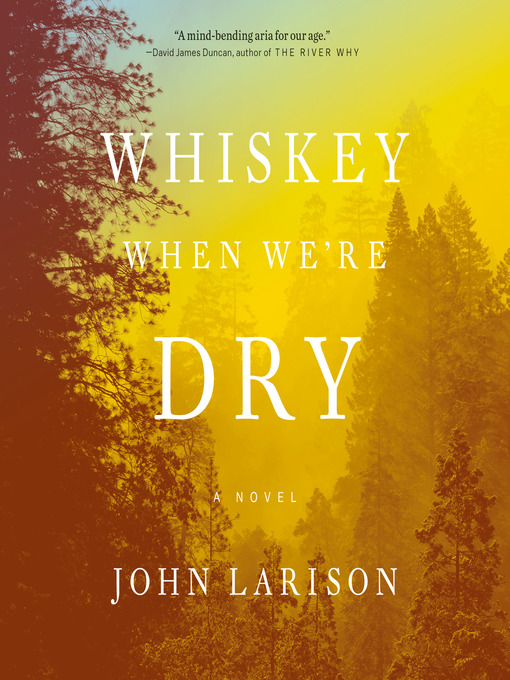
Whiskey When We're Dry
Written By John Larison
Narrated by Sophie Amoss
ISBN: 9780525631163
Run Time: 15:32:54
Summary:
In 1885, Jessilyn Harney sets out on to find her older brother who has become an outlaw since leaving home five years prior. As a girl going out into the unknown by herself, Jessilyn would be under constant threat by predatory men. It is because of this that Jessilyn decides to go on her quest disguised as a man.
During her journey, Jess uses her talent with sharpshooting to earn herself a living. Over the course of a few months, Jess earns a name for her(or rather him)self in addition to collecting information about her brother. As Jess learns more about her brother's crimes, she also learns that not everyone feels the same animosity towards him.
She soon comes to realize that everything in this life isn't black and white. While coming to grips with her own identity, Jess must also make choices that the wrong one could result in her demise. This book will keep its readers on the edge of their seats until the end.
What Makes A Western
Setting/Framing
Western novels take time with the illustration of its setting. The stories often takes place during a time when a family had to rely on what their land could provide them and the cattle they cared for. Because of all the time and descriptions that go into the landscape, the backdrop becomes a character in its own right.
Characterization
The main character of Westerns are typically depicted as a loner. Often the loner is set out on a quest that will right a wrong done to them or their loved ones. It could be multiple wrongs that take over the course of several books to rectify or an one time journey. Joyce Sarcisks compares Western Heroes to detectives in Hard Boiled Mystery books because of their cold exterior and because they sometimes have to solve mysteries as well.
Story Line
Western books often have a common theme of good versus evil. The hero is forced to up against an evil whether it be the sheriff or police, a rival, or "the establishment".
Pacing
Traditionally, Western books are smaller in size but that doesn't mean that they are fast paced books. With all of the world building that goes into the them, the details, although important, slow down the pace of the novel.
Language
Characters in Western novels are described as having limited education. Because of this, the language between characters and internal thoughts are simple in nature. The writing style of Westerns are lyrical and the sparse language is a key factor into making that happen.
Great For Readers Who Enjoy
*First Person Narratives
*Lyrical Writing Style
*Coming-Of-Age Stories
*Character Driven Novels
*Strong Female Characters
Read-A-Likes
* The untold by Courtney Collins
*Caroline by Sarah Elizabeth Miller
*The high divide by Lin Enger
During her journey, Jess uses her talent with sharpshooting to earn herself a living. Over the course of a few months, Jess earns a name for her(or rather him)self in addition to collecting information about her brother. As Jess learns more about her brother's crimes, she also learns that not everyone feels the same animosity towards him.
She soon comes to realize that everything in this life isn't black and white. While coming to grips with her own identity, Jess must also make choices that the wrong one could result in her demise. This book will keep its readers on the edge of their seats until the end.
What Makes A Western
Setting/Framing
Western novels take time with the illustration of its setting. The stories often takes place during a time when a family had to rely on what their land could provide them and the cattle they cared for. Because of all the time and descriptions that go into the landscape, the backdrop becomes a character in its own right.
Characterization
The main character of Westerns are typically depicted as a loner. Often the loner is set out on a quest that will right a wrong done to them or their loved ones. It could be multiple wrongs that take over the course of several books to rectify or an one time journey. Joyce Sarcisks compares Western Heroes to detectives in Hard Boiled Mystery books because of their cold exterior and because they sometimes have to solve mysteries as well.
Story Line
Western books often have a common theme of good versus evil. The hero is forced to up against an evil whether it be the sheriff or police, a rival, or "the establishment".
Pacing
Traditionally, Western books are smaller in size but that doesn't mean that they are fast paced books. With all of the world building that goes into the them, the details, although important, slow down the pace of the novel.
Language
Characters in Western novels are described as having limited education. Because of this, the language between characters and internal thoughts are simple in nature. The writing style of Westerns are lyrical and the sparse language is a key factor into making that happen.
Great For Readers Who Enjoy
*First Person Narratives
*Lyrical Writing Style
*Coming-Of-Age Stories
*Character Driven Novels
*Strong Female Characters
Read-A-Likes
* The untold by Courtney Collins
*Caroline by Sarah Elizabeth Miller
*The high divide by Lin Enger

This probably shouldn't remind me so much of Mulan, and yet... (Also, maybe a little bit Annie Get Your Gun?) This book sounds like it would make a great movie! I haven't read a lot of strongly women-centric/feminist books written by men- did you think this depiction/writing rang true? The few things I'd seen/read were more "girl punches stuff" than fully fleshed out characters, but this sounds like a good character study! I'd love to know what you think. Great post!
ReplyDeleteI like the sound of this one! I can't always handle a western because of problematic side characters and, living in the west, I get tired of shoot-outs and fallen women stories (THERE ARE SO MANY!) but this sounds like it embraces a lot of the good without the bad Western cliches.
ReplyDeleteI recently read Inland by Tea Obreht, and I was trying to figure out if it would classify as Western or Historical Fiction or Literary Fiction (Or all 3) and after reading this I think it has enough correlation to be classified as Western as well. If you liked this one, you might give Inland a try.
This sounds like a really interesting read! I have never once picked up a Western book. I just assumed the whole genre was something that I would not enjoy as I have never enjoyed other forms of media depicting the setting. I think maybe it is time a give it a chance. Great annotation!
ReplyDeleteWhen people ask me what kind of books I like, I usually say that I will read pretty much anything, except westerns and romance. This is not entirely fair, though, considering I have never once even tried to read a western book. I think I discriminate against them due to my intense dislike of all things country. But this book sounds very interesting and I think I've found a western that I will add to my TBR. So thanks for that! :)
ReplyDeleteExcellent annotation! Full points!
ReplyDelete